
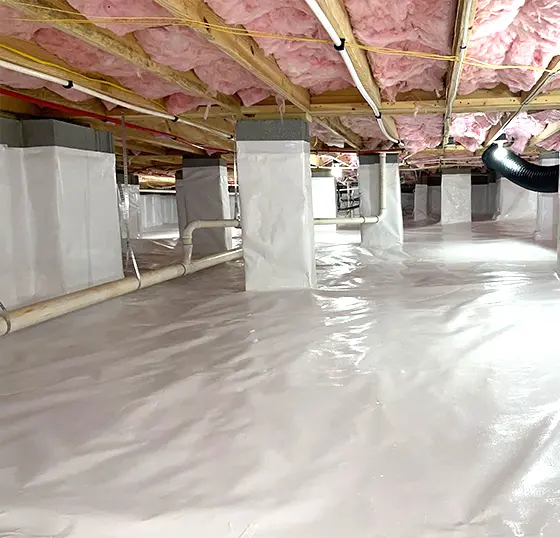
If your floors are cold in the winter, your energy bills keep climbing, or your basement has that damp, musty smell that never quite goes away, the answer is probably under your house. The question most Michigan homeowners run into is whether to insulate the crawl space, encapsulate it, or do both.
They are not the same thing. They solve different problems, and one is almost always the better choice for homes in this state. Here is how to tell which one your home actually needs.
What Crawl Space Insulation Does
Crawl space insulation controls heat transfer. Its job is to slow down how fast warm air escapes your home in the winter and how fast hot air gets in during the summer. That is it. Insulation does not manage moisture, seal out humid air, or protect against mold.
In a traditional vented crawl space, insulation is installed between the floor joists, the wood framing that runs beneath your first floor. Fiberglass batts are the most common material used in older Michigan homes, and they are also the most common material we see failing. Fiberglass absorbs moisture, sags over time, and eventually falls away from the subfloor entirely. If you have ever looked under a Michigan home and seen pink insulation hanging in strips, that is what happens after a few seasons of freeze-thaw and humidity.
In a sealed crawl space, insulation moves to the foundation walls instead of the floor. Closed-cell spray foam and rigid foam board are the go-to materials here because they resist moisture and hold up in damp conditions. This approach keeps the crawl space closer to indoor temperatures and protects pipes from freezing, which matters when ground frost reaches 42 inches deep in southern Michigan and over 60 inches in the Upper Peninsula.
Common Insulation Materials for Michigan Crawl Spaces
- Fiberglass batts are the cheapest option but perform poorly in damp conditions. They absorb water, lose R-value, and attract pests. Only appropriate in dry, vented crawl spaces, which are rare in Michigan.
- Rigid foam board (XPS) resists moisture, holds its shape, and delivers solid thermal performance on foundation walls. A reliable mid-range option for sealed crawl spaces.
- Closed-cell spray foam offers the highest R-value per inch, acts as its own vapor barrier, and seals every crack and gap in the foundation wall. It is the top performer for Michigan’s cold, humid climate.
What Crawl Space Encapsulation Does
Crawl space encapsulation is a moisture control system. It seals the entire crawl space, floor, walls, and vents, with a heavy-duty vapor barrier, typically 12 to 20 mil thick. Most encapsulation projects also include a dehumidifier to keep humidity below 55 to 60 percent, which is the threshold where mold starts growing.
Encapsulation does not add meaningful R-value on its own. A vapor barrier is not insulation. What it does is stop the cycle of moisture that ruins everything else underneath your house: the wood framing, the insulation, the air quality, and eventually the structural integrity of the home.
This is especially important in Michigan, where crawl spaces deal with moisture from every direction. Spring snowmelt saturates the soil around the foundation. Summer humidity pushes warm, damp air against cool foundation walls and creates condensation. Winter freeze-thaw cracks foundation openings wider each year. Homes near the Great Lakes get additional moisture loading from lake-effect weather patterns that keep humidity high well into fall.
What a Full Encapsulation Typically Includes
- Heavy-duty vapor barrier (12–20 mil) across the floor and up the walls
- Sealed foundation vents
- Commercial-grade dehumidifier
- Drainage improvements if standing water is present
- Rim joist sealing
The Real Difference
Insulation manages temperature. Encapsulation manages moisture. In a state like Michigan, moisture is usually the bigger problem.
A crawl space with great insulation but no moisture control will eventually lose that insulation to humidity, condensation, and water intrusion. Fiberglass batts in a vented crawl space might perform well for a year or two, then sag and fail as Michigan’s seasonal moisture cycle takes its toll. You end up paying for the same work twice: once for the insulation, and again to replace it and fix whatever moisture damaged in the meantime.
Encapsulation without insulation controls moisture effectively but does not do much for cold floors or energy bills. The crawl space stays dry, but heat still escapes through uninsulated walls and floor framing.
That is why most Michigan homes benefit from both.
Which One Does Your Home Need?
Insulation alone might work if your crawl space is consistently dry, you have no signs of moisture or mold, and cold floors are your only complaint. This is uncommon in Michigan, but it exists in some newer construction with solid drainage.
Encapsulation alone might work if moisture, musty odors, or mold are the primary concern and you are not dealing with significant energy loss or cold floors.
Both together is the right call for most Michigan homes. Sealing the crawl space first with a vapor barrier and dehumidifier solves the moisture problem. Adding wall insulation, either rigid foam board or closed-cell spray foam, then delivers the thermal performance and energy savings on top of a dry, stable environment. Typically, sealed, insulated crawl spaces outperform vented ones on energy efficiency, moisture control, and structural durability.
What About Energy Savings?
Properly sealing and insulating a crawl space can reduce heating and cooling costs by 10 to 20 percent, according to Department of Energy research. In a Michigan home where the furnace runs hard from November through March, that adds up fast.
Michigan utility providers like DTE Energy and Consumers Energy also offer rebate programs for insulation upgrades. It is worth asking your contractor about these before the project starts, because the paperwork is easier to handle upfront than after the fact.
Foundation Solutions 360 also offers financing options to help homeowners move forward without covering the full project at once.
Start With a Free Inspection
The best way to know whether your crawl space needs insulation, encapsulation, or both is to have someone look at it. Foundation Solutions 360 offers free crawl space inspections for Michigan homeowners. We evaluate moisture conditions, check insulation performance, and recommend the approach that fits your home and your goals.
Have more questions? Check our FAQ page for answers to common crawl space and foundation topics.
Crawl Space Insulation vs. Encapsulation FAQs
Is insulation or encapsulation better for a crawl space?
For most Michigan homes, both together give the best results. Encapsulation controls moisture and protects air quality, while insulation manages temperature and energy loss. One without the other leaves gaps in protection.
Can I just add insulation without encapsulating?
You can, but it is a risk in Michigan’s climate. Fiberglass insulation in a vented crawl space absorbs moisture and fails over time. If the crawl space stays dry year-round, insulation alone may hold up. In most cases, sealing the space first gives the insulation a much longer life.
What type of insulation is best for Michigan crawl spaces?
Closed-cell spray foam offers the highest R-value per inch and doubles as a moisture barrier, making it the top performer for Michigan conditions. Rigid foam board is a solid, more affordable alternative. Fiberglass batts are not recommended for crawl spaces in this climate.
How long does crawl space encapsulation last?
A properly installed encapsulation system with a quality vapor barrier and dehumidifier can last 20 to 25 years or more with minimal maintenance beyond periodic dehumidifier filter changes.